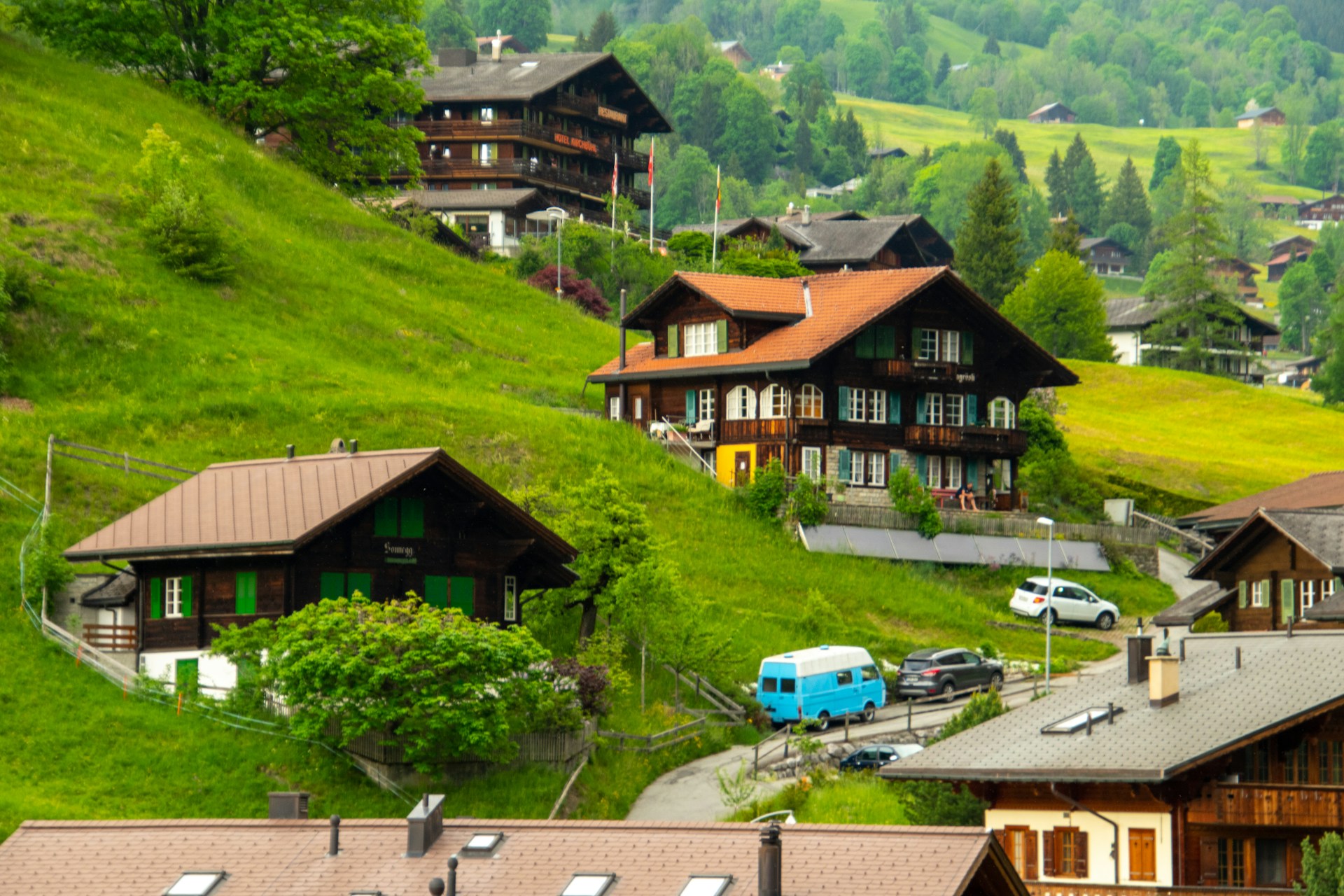
A classic alpine village directly beneath the most famous north face in mountaineering — gateway to Jungfraujoch via the Eiger Express and base for the First Cliff Walk, glacier hikes, and world-class skiing.
Explore Grindelwald on GetYourGuide →Grindelwald is an alpine village in the Bernese Oberland at 1,034 m, set in a broad valley that opens directly beneath the north face of the Eiger (3,967 m). The Eiger's north face — 1,800 m of near-vertical limestone and ice — dominates the view from the village in a way that is genuinely dramatic: arriving by train from Interlaken, the wall fills the entire southern horizon as the valley narrows.
Grindelwald is one of the two main bases for the Jungfrau region (the other being Lauterbrunnen), and since 2020 it has been the departure point for the Eiger Express — a modern 26-person gondola that carries visitors from Grindelwald Terminal to Eigergletscher (2,320 m) in about 15 minutes, cutting the travel time to Jungfraujoch considerably. Combined with the existing rack railway from Eigergletscher to Jungfraujoch (about 45 minutes), it is now the fastest route to the top.
The village itself is larger and more developed than Lauterbrunnen or Wengen — with hotels, restaurants, supermarkets, and a ski infrastructure that makes it a viable multi-day destination in its own right rather than just a transit point. In summer it is a hiking base; in winter it anchors one of the largest ski areas in the Bernese Alps.
GetYourGuide offers Jungfraujoch day trips via Grindelwald, First Cliff Walk experiences, guided hikes, and winter ski packages with instant confirmation.
View Grindelwald Experiences →The Nordwand (north face) of the Eiger is one of the most famous — and most feared — walls in mountaineering. At 1,800 m from base to summit, it is the largest north face in the Alps. Its reputation was built in the 1930s, when a series of fatal attempts to make the first ascent captured international attention; early climbers called it the Mordwand (Murder Wall). The first ascent was completed in 1938 by a German–Austrian team.
From the village, the entire face is visible to the naked eye. On summer days, climbers on the wall can be tracked with binoculars from the valley floor. The face sees approximately 4,000 attempts per year; it is a serious technical climb requiring substantial alpine experience, typically done in 2–3 days. Rescue operations on the Nordwand are a regular occurrence in bad weather.
For non-climbers, the view of the north face from Grindelwald village — particularly from the Kleine Scheidegg saddle above (2,061 m, reached by rack railway from Grindelwald) — is one of the most compelling mountain spectacles in Switzerland. Kleine Scheidegg sits directly at the base of the face and has been a viewpoint for alpinists and tourists since the 19th century.
Opened in December 2020, the Eiger Express is a 26-person gondola running from Grindelwald Terminal (a new purpose-built station below the village) to Eigergletscher (2,320 m) in approximately 15 minutes. It replaced a section of rack railway that previously took 45 minutes, reducing the total journey time from Grindelwald to Jungfraujoch to around 60 minutes — compared to 90 minutes or more via the older Kleine Scheidegg route.
The gondola itself is architecturally striking — large panoramic windows, a smooth ride across the glacier terrain, and views of the Eiger face at close range as it ascends. At Eigergletscher, the gondola connects directly to the Jungfrau Railway rack railway tunnel that runs through the interior of the Eiger and Mönch to the Jungfraujoch summit station (3,454 m).
The Eiger Express is included in Jungfrau Railway tickets and the Swiss Travel Pass (with a valid Top of Europe ticket). Grindelwald Terminal is a 10-minute bus ride from Grindelwald village and has its own train connection from Interlaken Ost. See our full Jungfraujoch guide for complete route planning and tips.
First (2,168 m) is the excursion area above Grindelwald, reached by gondola in about 25 minutes from the village. It offers one of the best combinations of views and activities in the Jungfrau region at a fraction of the cost and altitude of Jungfraujoch — making it particularly good for visitors with children, those sensitive to altitude, or those who want an active half-day outdoors rather than a passive summit experience.
The First Cliff Walk by Tissot is a 45-metre steel walkway and a suspended hanging bridge cantilevered out from the cliff edge at First, with the valley floor 2,000 m below. It extends the view directly over the Grindelwald valley, the Wetterhorn (3,692 m), and the Schreckhorn (4,078 m). The experience is vertiginous — the walkway sways slightly and the transparency of the floor panels is deliberate. It takes about 15–20 minutes to walk and is accessible to anyone who can manage the gondola ascent.
From First, a zip line (First Flyer) runs 800 m back towards the gondola station at speeds up to 84 km/h — the longest zip line in the Alps. A mountain cart (wheeled sledge) follows a 4 km track from First down to Bort, the middle gondola station. A trottibike (scooter bike) route descends to Grindelwald. All three are operated by Jungfrau Railways and can be booked in combination. The activities work best in summer and autumn; check availability in early season.
The Bachalpsee is an alpine lake 30 minutes on foot from the First gondola top station, sitting in an open plateau with direct views of the Wetterhorn, Schreckhorn, and Finsteraarhorn (4,274 m, the highest peak in the Bernese Alps). On calm mornings, the lake reflects the glacier peaks in perfect still water. The hike is easy on a well-maintained path, making it accessible for most fitness levels. It is one of the most photographed alpine lake views in Switzerland and genuinely lives up to it.
Kleine Scheidegg (2,061 m) is a mountain saddle between Grindelwald and Lauterbrunnen, reached by rack railway from either valley in about 35 minutes. It sits at the foot of the Eiger north face — close enough that you can hear rockfall and avalanches from the face on warm days — and is the starting point of the Jungfrau Railway through the mountain.
Even if you are not continuing to Jungfraujoch, Kleine Scheidegg is worth reaching for the view alone: the Eiger (3,967 m), Mönch (4,107 m), and Jungfrau (4,158 m) form a continuous glacier wall directly above, visible at their most dramatic from the terrace of the Kleine Scheidegg hotel. The classic hiking route between Grindelwald and Kleine Scheidegg (the Eiger Trail, 3 hours, one-way) follows the base of the north face — one of the most dramatic low-level walks in the Alps.
The Eiger Trail is a 3-hour hiking route (6 km, 700 m descent) from Eigergletscher (reached by Eiger Express or Jungfrau Railway) along the base of the Eiger north face to Alpiglen, then continuing to Grindelwald. The trail follows the foot of the wall at close range — passing beneath the major features of the north face and giving a climber's-eye perspective of the terrain. In summer, the path is well maintained and suitable for walkers in good footwear. The trail is signposted from Eigergletscher and can be done as a one-way downhill walk with public transport return from Grindelwald.
Grindelwald is part of the Jungfrau Ski Region — the largest ski area in the Bernese Alps, shared with Wengen, Mürren, and Grindelwald First. The region has approximately 213 km of marked runs across altitudes from 945 m to 2,971 m, served by over 45 lifts. The terrain suits intermediate skiers well, with long cruising runs from the Männlichen and First areas; there is limited extreme terrain compared to resorts in the Valais or Graubünden.
The Lauberhorn Race — the oldest and longest downhill race on the World Cup circuit — is held on the Lauberhorn piste above Wengen every January, reachable from Grindelwald. The course is 4.45 km long with a descent of 1,028 m; the race week transforms the Jungfrau region into one of the most-watched ski events in the world. Watching the race from the course is possible and popular — a remarkable experience if you happen to be in the area in mid-January.
Snow conditions in Grindelwald are reliable from mid-December to late March. The village altitude (1,034 m) is lower than some resorts, meaning the lower slopes can be affected by warm spells in mild winters, but the Eiger Express and gondolas into the First area at 2,000+ m maintain good cover through most seasons.
The Gletscherschlucht (Glacier Gorge) is a narrow gorge carved by the Lower Grindelwald Glacier on the valley floor, reached by a 20-minute walk from the village. A wooden walkway has been built into the rock face of the gorge, allowing visitors to walk through the canyon with meltwater rushing below and the polished glacier-carved walls within arm's reach on both sides. The gorge is open May to October; admission is around CHF 8. It is one of the more unusual geological features accessible on foot from the village and is appropriate for all ages.
The choice between basing in Grindelwald or Interlaken depends on priorities. Grindelwald gives a true mountain-village atmosphere, is 35 minutes closer to Jungfraujoch and the First gondola, and has the Eiger north face as a constant backdrop. It suits visitors who want to feel in the mountains rather than in a transit hub. Interlaken has more accommodation options, lower prices, a wider restaurant scene, and is the main interchange for all Jungfrau region trains. Visitors with limited time often base in Interlaken and day-trip to Grindelwald; those staying 3+ nights in the region often prefer Grindelwald itself.
Grindelwald has two distinct seasons. Summer (mid-June to mid-October) is the main hiking season — paths are clear, the Bachalpsee hike is at its best, First and Kleine Scheidegg are fully open. The shoulder months of May and early June can be unpredictable: snow on higher paths, some lifts not yet open. Winter (December to March) is the ski season — the village is busiest Christmas–New Year and in February. April is the quietest month, with skiing ending and summer activities not yet open.
Book guided tours and activities in Grindelwald on GetYourGuide — instant confirmation, free cancellation on most bookings.
Browse the full selection of guided tours, activities, and day trips in Grindelwald on GetYourGuide — free cancellation on most bookings.
View All Experiences in Grindelwald →Grindelwald has a wide range of accommodation concentrated in and around the village. It is more expensive than Interlaken but less so than comparable ski resorts in the Valais. Booking in advance is essential in July–August and in the Christmas–New Year ski peak.
Compare all available hotels in Grindelwald on Klook — filter by price, location, and amenities.
View All Hotels in Grindelwald on Klook →Guided day trips from Grindelwald to Jungfraujoch include the Eiger Express gondola and all rail connections to Europe's highest railway station.
View Jungfraujoch Day Trips →Grindelwald is closer to Jungfraujoch and gives the mountain atmosphere many visitors want; the Eiger Express from Grindelwald Terminal is the fastest route to the top. Interlaken has more accommodation, lower prices, and better transport connections to the rest of Switzerland. For a stay of 2–3 nights focused on the Jungfrau region, Grindelwald is the better choice. For a single night or as part of a broader Swiss itinerary, Interlaken is more practical.
The First Cliff Walk is a 45-metre steel walkway and hanging bridge built into the cliff face at First (2,168 m), with the valley floor roughly 2,000 m below. It is vertiginous — the walkway has transparent floor sections and sways slightly in wind. Most visitors find it exhilarating rather than frightening, but those with a significant fear of heights should be aware before going. No climbing or special equipment is needed; the walkway is a normal footpath with railings. The views from it — the Grindelwald valley, the Wetterhorn, and on clear days the Bernese Alps — are exceptional.
The old route from Grindelwald goes by train to Kleine Scheidegg (35 min) and then by Jungfrau Railway through the mountain to Jungfraujoch (50 min) — about 90 minutes total from Grindelwald. The Eiger Express gondola from Grindelwald Terminal reaches Eigergletscher in 15 minutes, connecting there to the Jungfrau Railway tunnel for a further 45 minutes — about 60 minutes total. The Eiger Express is faster and more scenic at the gondola stage; the Kleine Scheidegg route allows a stop at the saddle with its famous Eiger view. Both are valid options; the Eiger Express is better for minimising time, the Kleine Scheidegg route for maximising the journey experience.
Yes — the Eiger Trail (6 km, 3 hours one way) runs from Eigergletscher along the base of the Eiger north face to Alpiglen and then to Grindelwald. It is best done downhill (Eigergletscher to Grindelwald) rather than uphill. The trail is well marked and maintained; no technical climbing is required. It is one of the most dramatic low-level walks in the Alps and gives the closest non-climbing view of the north face available on foot. Take the Eiger Express up to Eigergletscher and walk back down.
Yes — Grindelwald in winter offers winter hiking on maintained snowshoe trails, toboggan runs, ice skating on an outdoor rink in the village, and the regular gondola service to First for snow views without skiing. The village atmosphere in winter is pleasant and quieter than in peak summer. Jungfraujoch is open year-round and is if anything more spectacular in winter conditions. The main limitation is that some summer hiking trails are inaccessible or dangerous without alpine equipment.
Grindelwald village sits at 1,034 m — well below the altitude at which most people experience effects. The vast majority of visitors have no symptoms at this height. Altitude effects become possible above 2,500 m; if you ascend to Jungfraujoch (3,454 m) in one day from a low-altitude starting point, mild symptoms (headache, fatigue, slight breathlessness) are common and usually pass within an hour of arrival. Drinking water, moving slowly, and avoiding alcohol on the ascent day all help. Children and older visitors generally adapt well; see our Jungfraujoch guide for more on altitude preparation.


