8 hours, 291 bridges, 91 tunnels — from the car-free village of Zermatt to the glamorous resort of St. Moritz across the heart of the Swiss Alps.
Check Availability on GetYourGuide →The Glacier Express is a panoramic train operated jointly by the Matterhorn Gotthard Bahn (MGB) and the Rhaetian Railway (RhB). It runs daily between Zermatt and St. Moritz — or Davos during part of the year — crossing three Alpine passes and passing through some of the most dramatic mountain scenery in Europe.
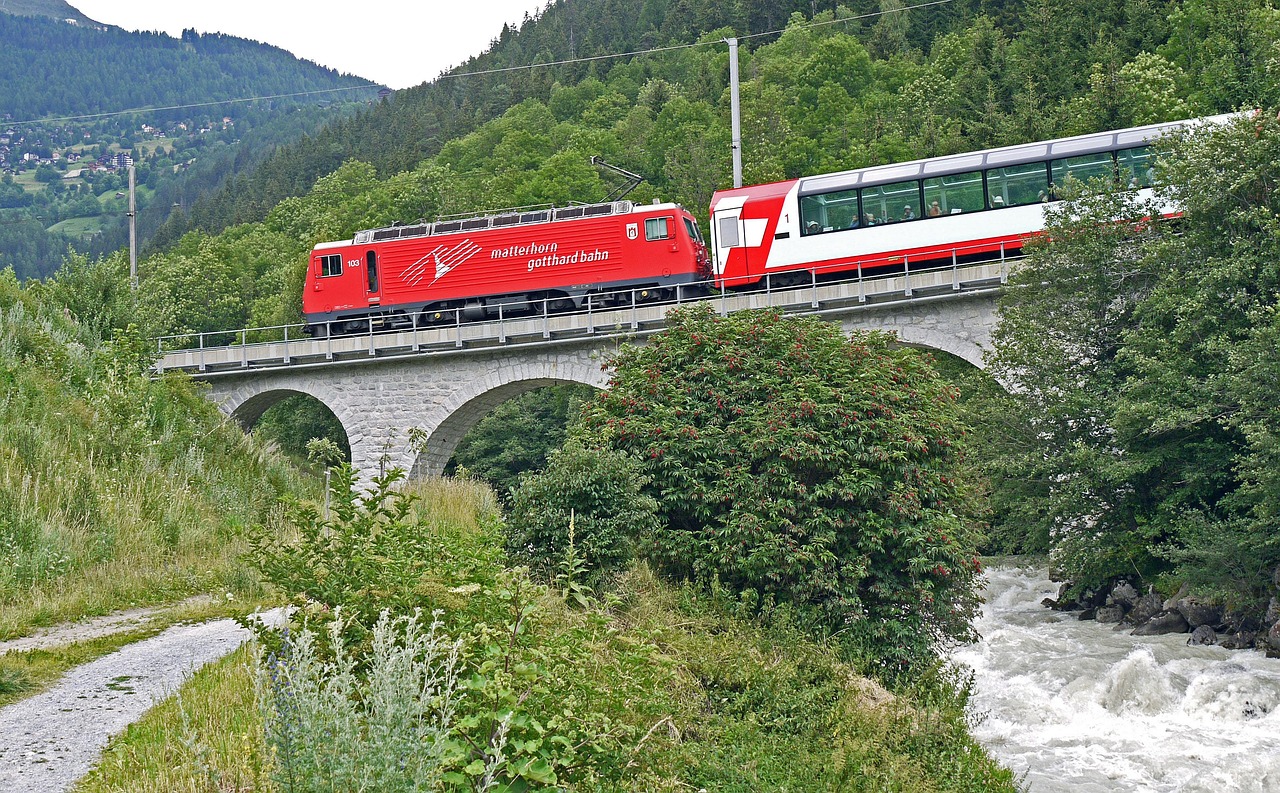
Despite being called an "express," it is famously one of the slowest long-distance trains in the world. The 8-hour journey is entirely intentional: the route winds through narrow valleys, over high viaducts, and through mountain tunnels at a pace designed for scenery, not speed. The train crosses 291 bridges, passes through 91 tunnels, and reaches a maximum altitude of 2,033 m at the Oberalp Pass.
GetYourGuide offers Glacier Express experiences and day trips with instant confirmation. Check the specific conditions of each offer — seat guarantee, Swiss Travel Pass compatibility, and meal inclusions vary by package.
View Experiences on GetYourGuide →The journey begins in Zermatt, the car-free village beneath the Matterhorn. As the train climbs out of the valley, the iconic pyramid of the Matterhorn appears behind you — look back for the best view in the first few minutes. The train follows the Matter Valley north through Visp, then turns east into the Rhône Valley and climbs steeply toward Brig. From Brig, the route enters the Goms valley — a high, wide alpine plateau lined with traditional wooden villages and, in winter, completely blanketed in snow. The train passes through Fiesch, home to the Aletsch Glacier (the largest in the Alps), before ascending to the Furka Base Tunnel and emerging near Andermatt, a crossroads village beneath the Gotthard massif.
This is the highest section of the journey. From Andermatt the train climbs to the Oberalp Pass at 2,033 m — the highest point on the route — where the landscape is bare, windswept, and extraordinary in its starkness. In winter this section is particularly dramatic, with the train cutting through walls of snow. After the pass, the train descends into the Vorderrhein valley and arrives at Disentis/Mustér, a small town with a Benedictine monastery visible from the train.
From Disentis, the RhB takes over and the train continues through the Rhine gorge — the so-called Swiss Grand Canyon — a dramatic stretch of steep rocky walls carved by the Rhine River. This section between Ilanz and Reichenau is one of the lesser-discussed highlights of the route. After Chur (the oldest city in Switzerland), the train climbs the Albula line via spiral tunnels and stone viaducts — the same UNESCO-listed section used by the Bernina Express — before arriving at St. Moritz in the late afternoon.
For the Zermatt → St. Moritz direction:
As with the Bernina Express, the panoramic cars have large windows that extend into the roof, so both sides offer excellent views. The main difference is in specific moments — it is worth researching the exact kilometre-points if you want to photograph a particular landmark.
Unlike the Bernina Express, the Glacier Express has a full dining car — one of its distinctive features. A three-course lunch is served at your seat, and the train is well-known for its tilted wine glasses, designed to compensate for the steep gradients on the route. Meal service is typically available at midday and the menu changes seasonally.
Whether a meal is included in your booking depends on your ticket or tour package — check the conditions of your specific experience. On some packages it is included; on others it is an add-on or can be purchased on board.
A seat reservation is mandatory for the Glacier Express panoramic cars. If you hold a Swiss Travel Pass or Eurail/Interrail pass, these cover the base fare but the reservation supplement must be arranged through whoever issued your pass — check with your ticket provider for the correct process.
Because the journey takes a full day in each direction, most travellers do it one-way and travel back by a different route (e.g. via Zurich by InterCity train). A popular multi-day itinerary combines the Glacier Express one way with the Bernina Express the other, using St. Moritz as the meeting point.
GetYourGuide has experiences in both Zermatt and St. Moritz — consider adding a guided activity at either end of your Glacier Express journey.
Browse Experiences on GetYourGuide →ℹ️ Several answers below depend on your specific ticket or tour package. Always check the conditions of your booking before travelling.
On the official Glacier Express panoramic service, a seat reservation is mandatory and your seat is assigned. If you purchased a guided tour or packaged experience, check your booking confirmation — some packages include a reserved panoramic seat, while others may use different rolling stock. Contact whoever sold you the ticket if you are unsure.
Rail passes (Swiss Travel Pass, Eurail, Interrail) cover the base fare but not the mandatory seat reservation supplement. The reservation must be arranged through whoever issued your pass. If you book via GetYourGuide, those packages are standalone and pass discounts do not apply — check the specific offer details.
The full journey between Zermatt and St. Moritz takes approximately 8 hours. Some packages may cover only a portion of the route (e.g. Zermatt to Andermatt or Andermatt to St. Moritz). Always check the start and end points of your specific booking.
With a standard rail ticket or pass, you can generally break the journey at any station and continue on a later service (a new seat reservation would be needed). If you purchased a guided tour or packaged day trip, stopping independently may not be included — check the itinerary and conditions of your specific experience.
Yes — unlike the Bernina Express, the Glacier Express has a full dining car with seated table service. A seasonal three-course lunch menu is available. Whether a meal is included in your booking depends on your ticket or package; it is an add-on for some and included for others. Check your booking conditions for details.
The route is scenic year-round and any season offers something special. Summer (June–September) is the most popular, with green valleys and clear views — seats fill up fast so book early. Autumn brings golden larches and fewer crowds. Winter is dramatic in deep snow but can have weather delays on higher sections. Spring is the quietest and most affordable period.
Dress in layers — the train is heated, but temperatures at the Oberalp Pass (2,033 m) can be very different from Zermatt or St. Moritz at valley level. Luggage space is limited in the panoramic cars, so travelling light is advisable. A window cloth or microfibre towel helps reduce reflections for photography. Binoculars are useful for spotting distant peaks and glaciers.
The Glacier Express has adapted seating areas and step-free boarding at major stations. Some smaller intermediate stops have limited accessibility. If you have specific mobility requirements, check the conditions of your booking and contact whoever sold you the ticket to confirm what assistance is available on your specific journey.